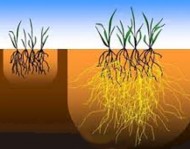

MycorrPlus-A and MycorrPlus-O are highly concentrated organic fertilizers that can accomplish all of the above.
Instead of feeding the plant directly with NPK, we supply a host of microorganisms to convert tied up nutrients in the soil into available plant food.
MycorrPlus-A and O are very well balanced, containing the following:
MycorrPlus is a unique product that helps with 3 vital functions for the rapid building of rich top soil:
Call 1-888-588-3139 to speak to a health consultant
Email us at info@ag-usa.net
Check this out! We have an application for every budget
Read the following article and let it inspire you with the possibilities
Dr. Christine Jones has written an exceptional article which was published in the March, 2015 issue of AcresUSA. This article does a great job of explaining how GroPal Balance is able to accomplish all it does. Click here to read her article.
In her interview, Dr. Christine Jones explains the best way to increase the amount of carbon (sugars) the plant exudes through the roots into the soil, and how this is a wonderful way to increase the RFV and brix of the plant.
Dr. Jones says that the formation of topsoil can be breathtakingly rapid. She explains that the reason for this is that most of the ingredients for new topsoil come from the atmosphere, including carbon, hydrogen, oxygen and nitrogen. Plants utilize these to produce liquid carbon, which they then exude into the soil through their roots in order to feed soil microbes. It is this flow of liquid carbon (sugars) into the soil that is the primary means by which rich topsoil is formed.
MycorrPlus-A and O help to
improve the soil
and the plants growing in it
MycorrPlus provides a host of nutrients, including a rich supply of the trace minerals found in ocean water. These nutrients supply the soil with what it needs so that it can supply plants with the energy they need to reach their maximum potential.
MycorrPlus provides 70+ beneficial bacteria plus
4 strains of mycorrhizal fungi.
These micro-organisms help to create balance in the soil. Balance
is everything! The
balance created causes the soil to possess a high energy level.
When this energy is made available to plants, it energizes them
to sequester sugars to feed the micro-organisms in the soil.
As the micro-organisms are nurtured and fed by the plant, they in turn make nutrients and energy available to the plant. This enables the plant to sequester even more sugars into the soil. This relationship between microbes and plant result in plants being able to attain their optimum potential.
The Best Way to Form Topsoil
Many scientists have confused themselves — and the general public — by assuming soil carbon sequestration and the making of topsoil occurs as a result of the decomposition of organic matter such as crop residues.
In stark contrast, Dr. Jones points out that most of the elements needed to create topsoil are found in the atmosphere and that the creation of new soil centers around carbon. Compost may help, but it is simply not the best way to create topsoil.
A plant can acquire between 85 to 90 percent of the building
materials it needs from the air to create liquid carbon. The rest of
the nutrients are provided from the soil. Soil microbes use this
liquid carbon as an energy source to help them convert tied up
nutrients into available plant food. In the process, the sugars
emitted by the roots act as a glue to create complex soil structure,
which includes stable forms of carbon and humus.
New topsoil is rapidly created in this environment. Once
MycorrPlus is activated with at least 1.1” of moisture and a soil
temperature above 45 degrees, almost immediately plants begin to
secrete liquid carbon into the soil, and it is only a matter of
weeks before new soil begins to form.
This is superior to results seen by using a bio stimulant, including
natural plant or seaweed extracts. MycorrPlus-A and O contain micro and macro nutrients needed by the plant, plus
4 strains of mycorrhizal fungi and over 70
strains of aerobic bacteria that help the soil to convert nutrients tied
up in the soil into
plant food.
Carbon is needed for soil structuring and water holding. As liquid
carbon streams into the aggregates via the roots or fungal linkages,
it enables the production of glues and gums that hold soil particles
together.
Establishing a good soil structure enables nitrogen-fixing bacteria
to function. You will rarely see a nitrogen deficient plant in a
healthy natural ecosystem. Ammonia that is fixed from the air is
rapidly converted into an amino acid or incorporated into a humic
polymer. These organic forms of nitrogen cannot be leached or
volatilized.
With rapid carbon sequestering, the growth rate of plants can
quickly increase. That is the power of properly functioning soil.
As Dr. Jones pointed out, if plants can obtain phosphorus and potash easily, they will stop pumping carbon into the soil to support their microbial partners. This interruption of the carbon flow to the soil reduces aggregation and the forming of new topsoil.
Grains like corn or wheat will probably need additional nitrogen.
As Dr. Jones stated, including some clovers or peas with your wheat
or some vetch with your corn is another way of supplying the soil
with extra organic nitrogen. As is mentioned in her article, in
biologically active soils, Dr. Jones actually found the
use of NPK to be counterproductive.
Remember that a soil test can only tell you what is available to
plants by passive uptake of inorganic nutrients, like those provided
by NPK fertilizers. The other 97 percent of minerals, those made
available by microbes, are not inorganic minerals and will simply
not be visible on a standard soil test.
By nurturing the aerobic microbes in the soil, we can increase the
availability of a huge variety of minerals and trace elements — most
of which are not contained in fertilizers.
Keep the soil covered and don’t till it
Tilling the soil or allowing soil to remain bare for a number of months disrupts soil microbial life, as well as mycorrhizal fungi. Plant a cover crop and use companion crops with cash crops.
Remember, plants colonized by mycorrhizal fungi can grow much more
robustly even though they’re giving away as much as half of the
sugars that they make in photosynthesis through their roots. They
photosynthesize faster, producing more sugars, which can in turn be
shared with the soil.
In regions with a hot, dry summer, evaporation is enemy number one.
Bare soil will be significantly
hotter and lose more moisture than covered soil. Aggregates will
break down unless the soil is alive. Aggregation is absolutely vital
for moisture infiltration and retention.
Try to minimize chemical applications
This includes fungicides, insecticides and
herbicides. It is a no-brainer that something designed to kill
things is going to do just that.
Chemical applications can inhibit the
mycorrhizal fungi that are essential
to crop nutrition and soil building. When mycorrhizal fungi are kept from
functioning properly, plants can no longer use them to obtain the
trace elements they need to fight fungal diseases.
Overcoming weeds
When we spray for weeds it creates bare ground and the weed seed
that’s there means the weeds simply come back.
Some weeds have deep roots that help to bring up nutrients. Leaving
them can mean that better quality plants will eventually be able to
grow in the improved soil and replace the weeds. A little patience
may be needed while soils improve.
For dry regions, perennial grasses have incredibly deep root systems
and form mycorrhizae associations that help them survive during dry
periods. They will soon create their own microclimate to help them
overcome a lack of water and thrive, displacing weeds.
A diversity of plants actually improves nutrient acquisition and
water retention, and helps to fill in gaps in the soil.
Multi-species pasture cropping can help to displace unwanted weeds.
Rotational grazing can help, too. For cash crops, multi-species
cover crops and companion crops can help with weed control and soil
improvement, as soils move toward fungal dominance.
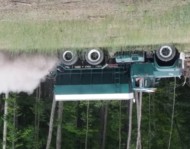
For most applications, just 32 to 64 ounces per acre is all that is needed.
Want to learn more?
Click below for a wealth of information.
AcresUSA interview with Carbon Sequestration specialist Dr. Christine Jones
Click here to read Dr. Jones' article highlighting the need and benefits of building more carbon in our soils.